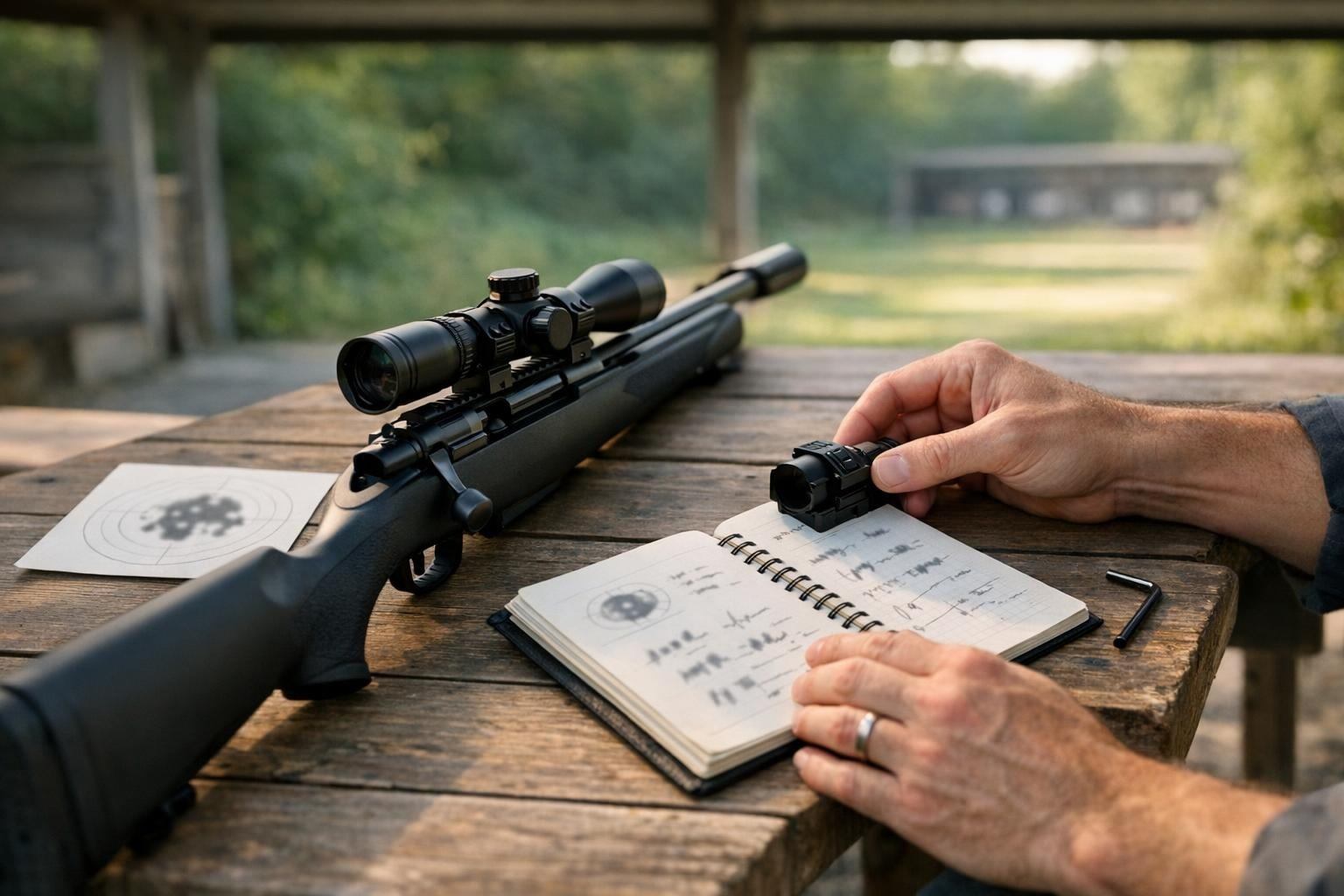
A shooter's log for his air rifle can reveal a lot of information about the shots he makes and also about his own habits as a shooter and about his gun. If his results are not as consistent as he would like then the cause could be due to a number of things, for example, the shooter being tired, changes to his shooting technique or possible faults with his gun.
Start with Context for Your Entries
You must set the scene for your entries by including details of the date, the location, the target(s) used, the pellet(s) you're using, and any other factors which could have affected your shooting on that day. A session shot at indoor ranges is clearly very different from one shot at outdoor ranges, with differing environmental factors which can have a great impact upon your results. In this respect, even the type of target can have a huge bearing upon results – flat surfaced targets shot at ranges used for plaque shooting at indoor ranges, for example, will clearly be very different to three dimensional targets shot at outdoor ranges.
The setup of the air rifle and sights should also be noted. Also note the type of pellets that were shot, and make separate notes for each rifle, even if they seem very similar. There can be large differences due to seemingly minor variations in air rifle design.
Using a simple notebook for your air rifle practice sessions is the best way to organize records. The need to record extensive amounts of data to analyze your shots is limited to answering one simple question: What changed for the worse with your shooting?
Assess Your Shooting Technique
The shooter can contribute to inconsistencies on the range through shooter fatigue, changes in shooting technique such as a different cheek weld, an inconsistent grip pressure, etc. Make a note of your physical and mental state prior to commencing each practice session. Were you feeling more fatigued in your latter shots, did your first groups look tight but your subsequent shots started to open up as you speeded up?
Recording your shooting routine provides further insight. Did you use the same supported position for all your shots? Did you allow time for the rifle to settle between shots? In your log entries it is better to explain poor results rather than just labeling them, for example: 'First groups were good but subsequent shots opened up vertically. shooter was hurrying.'
Spot Trends Over Isolated Incidents
While you hope that your less than perfect groups are unusual and will never happen again, they often reappear in subsequent shooting sessions. Look to see if unusual groups are surrounded by better ones. Go back and review your previous shooting sessions that were held under similar conditions. Have you experienced the same spread pattern before?
Note how the shots have dispersed and note if there are any shifts in normal shot patterns. A widely scattered shot may indicate an improper shooting position or the shots are not releasing properly from the ammunition. A consistent shift in patterns from shot to shot after handling the air rifle could indicate a problem with the sight or scope mounting. Again refer to the rifle's instructions for appropriate checking and the results of controlled experiments for reference.
Remember that you must change one factor each time you go shooting in order to determine the cause of a change in your results. Document your experiments, and then you will be able to log up the results of your next session.
Regular Maintenance Checks Based on Your Log
First, when your gun is not performing as expected, make sure it is safe to open her up. If necessary, cycle the action to make sure no shots are going to go off by accident. Make sure the muzzle is safely pointed away from you and then refer to your manual for any specific procedures your gun may require before disassembling.
Loss of accuracy is usually the result of a change in one of the basic fundamentals and should be investigated in that order.
– Sights check, to make sure that they have not shifted. All screws are tightened as before.
– Look for any visible damage or debris on accessible external parts.
– Check external parts of rifle for signs of impact or blockage, only check inside barrel and action as instructed in rifle's manual, never force anything through barrel and never use unsuitable cleaning equipment.
– Examine your pellets for external damage or malformations. Also check how the pellets have been stored.
– unusual resistance while cocking, or any change in trigger sensitivity.
Also remember that there are situations where a simple fix won't suffice. Sudden discharges, air leaks or other drastic changes in you rifle's behavior require the expertise of a qualified technician or possibly even the manufacturer themselves. Restrict yourself to basic field stripping and always, always consult the rifle's manual before attempting to perform any sort of repairs.
Documenting Changes to Ammunition and Setup
Documentation of the different types of pellets you are shooting with is very important. Make sure to record the brand and model as well as the date they were introduced. Record any immediate changes as well as any delayed changes in performance. Make sure that your pellet containers are organized in such a manner so as to not get mixed up.
Similarly, make note of any changes to other parts of your shooting setup, such as the sights, shooting rests, targets and even your position when shooting. Note whether you have changed to shooting from a bench to standing for example, or if you have changed the way you attach the target to the firing point. Also make note of any changes to the ambient light when you shoot.
Future purchases will be so much easier to review with all of the previous combinations that you have tested for satisfactory results. Remember that poor results with a rifle may be due to the rifle itself or possibly the type of pellets that you are using or even your shooting setup.
Analyze Your Notes for Better Decisions
It's also important to revisit your log entries after several shooting sessions. Look for certain trends or problems with your shooting groups. Do they widen as you continue to shoot? Does your air rifle's performance deteriorate after being moved from one location to another? Are there certain types of ammunition or shooting setups that don't seem to be doing as well as others? If you find that you are encountering any of these problems on a consistent basis, then you need to stop shooting and investigate further. Always refer to the air rifle's manual, and be sure to follow proper and safe shooting procedures.
Be sure to record any maintenance or adjustments performed on your rifle. Who worked on it and what exactly was done are important for later reference and to avoid having to resort to guessing. By keeping a log you are going to be able to track and notice the earliest signs of potential problems. You will be able to make safe and informed decisions based on your logged data. Laws and local range regulations are often updated so make sure to keep yourself up to date with regards to how you can store, transport and use your air rifle and gear.